
- All
- Product Name
- Product Keyword
- Product Model
- Product Summary
- Product Description
- Multi Field Search
Views: 0 Author: Site Editor Publish Time: 2026-08-16 Origin: Site


Deploying a heavy-duty crusher represents a massive capital investment. The stakes are incredibly high right from day one. A mismatch between your equipment and your rock type causes severe problems. It leads to catastrophic downtime and accelerates machine wear. It also ruins your return on investment. You must choose your machinery carefully. This article moves beyond generic capability claims. We provide a technical, evidence-based evaluation for quarry operators. You will learn exactly what materials process efficiently. We also outline what materials you must avoid at all costs. You will discover how specific material characteristics dictate equipment configuration. By the end, you can confidently match your rock profile to the right crushing technology. You will safeguard your operation and maximize daily output.
Heavy duty jaw crushers are engineered for highly abrasive, hard materials with compressive strengths up to 320 MPa (e.g., granite, basalt, iron ore).
Equipment failure rarely stems from rock hardness alone; it is most often caused by excessive moisture, sticky fines, or un-crushable tramp metal exceeding safety tolerances.
Choosing the right machine requires matching the material’s silica content and abrasiveness to specific manganese steel jaw plate profiles.
Material feed size must be strictly controlled to respect the crusher's nip angle and feed opening, preventing bridging and maximizing throughput.
You rely on primary crushing stages to handle massive volumes of raw material. A well-configured high capacity jaw crusher excels in specific environments. It uses sheer compressive force to shatter rock. This mechanism makes it far superior to impact crushers for certain applications.
These machines thrive on challenging geological formations. Granite, basalt, quartzite, and river gravel are prime examples. Impact crushers struggle here because high-velocity blows destroy blow bars quickly. Jaw crushers operate differently. They squeeze the rock between two heavy plates until it fractures along natural fault lines. This slow, deliberate compression handles extreme abrasiveness beautifully. It keeps wear part consumption predictable. Operators enjoy stable production rates even when processing the toughest igneous rocks.
Mineral extraction operations demand rugged reliability. A robust mining jaw crusher serves as the frontline workhorse. It easily handles primary reduction for heavy ores. Common applications include iron ore, copper ore, and gold-bearing quartz. These materials possess high bulk densities. They require immense crushing forces to liberate valuable minerals from the host rock. Heavy-duty flywheels provide the necessary inertia. They power through tough ore bodies without stalling the electric motor.
Urban demolition presents unique material challenges. Heavy concrete slabs require immense bite force. A jaw crusher easily breaks down thick, cured concrete. It also handles moderate amounts of reinforced steel rebar. The V-shaped chamber pulls concrete chunks downward, fracturing the cement and freeing the metal. However, operators must install a strong magnetic separator downstream. This prevents liberated steel from shredding expensive conveyor belts later in the circuit.
Even the strongest equipment has mechanical boundaries. Pushing a machine beyond its design limits guarantees failure. You must understand what materials create dangerous operating conditions. These hazards often lurk within seemingly normal material feeds.
Moisture is the silent killer of crushing efficiency. Feeding wet clay, mud, or high-moisture shale creates instant problems. These materials do not fracture. Instead, they compress into dense, sticky blocks. They glue themselves to the corrugated jaw plates. This phenomenon is known as "packing" in the crushing chamber. Packing artificially reduces the Closed Side Setting (CSS). It forces the motor to draw excessive amperage. Eventually, the machine will stall completely. You face hours of dangerous, manual chamber clearing.
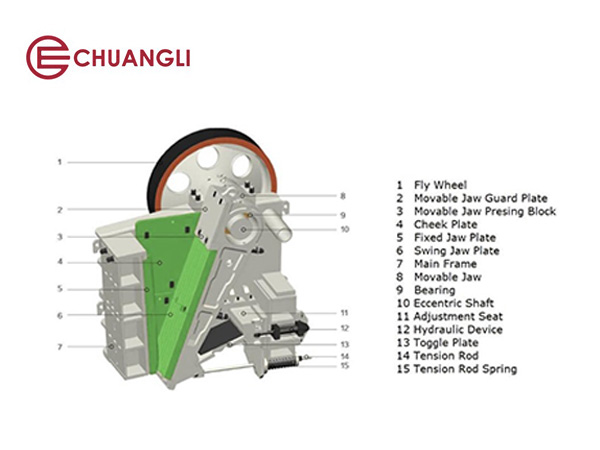
Not all metal acts the same inside a crushing chamber. Thin rebar from demolition jobs bends and passes through safely. Solid steel inclusions are fatal. Excavator teeth, loader bucket lips, and solid steel billets will not compress. When these enter the chamber, they trigger an immediate mechanical overload. Fortunately, the machine features a safety mechanism. The toggle plate acts as a mechanical fuse. It fractures intentionally to drop the jaw and save the main frame. Replacing a toggle plate is cheap. Repairing a cracked frame costs thousands.
Some materials completely absorb compressive forces. Wood blocks, heavy rubber tires, and thick plastics cause major disruptions. The jaw simply squeezes them, and they expand back to their original shape on the upstroke. They bounce around inside the chamber endlessly. This creates extreme friction and heat. It wastes energy and blocks new rock from entering the crushing zone. Always screen out organic and elastic debris before primary processing.
You cannot buy machinery based on physical dimensions alone. The precise characteristics of your rock dictate the required engineering specifications. Understanding these variables ensures you select the correct equipment configuration.
Unconfined Compressive Strength measures how much pressure rock withstands before failing. A standard heavy-duty machine processes materials up to 320 MPa. Examples include dense basalts and taconite ores. Materials exceeding this baseline require specialized chamber designs. They need thicker main frames and slower eccentric shaft speeds. Operating a standard crusher on 400 MPa rock causes extreme frame stress. Micro-fractures will develop in the steel casting over time.
Hardness and abrasiveness are completely different metrics. Silica acts like liquid sandpaper inside the crushing chamber. High silica content directly correlates with rapid wear part consumption. It heavily impacts your maintenance scheduling and operational budgets. If your rock contains more than 60% silica, you must plan for frequent jaw plate swaps. Ignoring silica content leads to bald jaw plates. Bald plates lose their bite, reduce capacity, and increase power consumption.
Physics governs the crushing chamber. The nip angle is the angle between the fixed and moving jaw. If a rock is too large, it cannot enter this angle properly. The jaw will spit the rock upward instead of pulling it down. Oversized boulders exceeding 80% of the gape size cause "bridging." They wedge across the feed opening. This requires operators to halt production and deploy hydraulic rock breakers. Controlling your blasting practices ensures optimal feed size and prevents severe bottlenecks.
The steel plates touching the rock determine your operational success. A Heavy Duty Jaw Crusher relies on specialized metallurgy. You must match the plate design to your specific material profile.
Table 1: Jaw Plate Profile Selection Matrix
Tooth Profile | Ideal Material Type | Primary Advantage |
|---|---|---|
Standard / Corrugated | Highly abrasive rock, granite, gravel | Balances grip and wear life. Excellent fine generation. |
Flat Profile | Soft to medium rock, limestone | Prevents slabbing and elongated particle shapes. |
Heavy Duty / Thickened | Massive, blocky mining ores | Maximum impact resistance for severe primary crushing. |
Jaw plates utilize manganese steel because it work-hardens under impact. The initial surface is relatively soft. Repeated impacts from heavy rocks harden the outer layer while the core remains ductile. You must choose the right percentage based on impact-to-abrasion ratios.
14% Manganese: Ideal for highly abrasive but low-impact materials like river gravel. It provides excellent wear life when sheer impact forces remain low.
18% Manganese: The industry standard. It offers a balanced performance for mixed quarries processing limestone and moderate granite.
22% Manganese: Reserved for extreme impact applications. When dropping massive boulders into the chamber, this grade work-hardens rapidly to prevent cracking.
The shape of the plate surface controls material flow. Corrugated profiles are best for standard abrasive rock. They concentrate crushing forces on point loads, fracturing hard stones efficiently. Flat plates suit softer rocks where slabbing poses an issue. Slabbing occurs when flat rocks slip through the chamber uncrushed. Finally, thickened profiles are mandatory for primary mining applications. They handle massive, blocky ores without premature structural failure.
Never rely on generic brochures to make a purchasing decision. You need hard data. Follow this diagnostic framework before finalizing any equipment sizing.
Conducting a Bond Work Index Test: Serious buyers must test their rock. A Bond Work Index test reveals the exact crushability of your deposit. It calculates the precise energy required to reduce your rock to a specific size. This prevents severe under-sizing of your motor and flywheel.
Evaluating Site-Specific Variables: Laboratory tests do not account for daily weather. Assess how seasonal moisture additions impact your feed material. Evaluate your blasting practices. Poor blasting yields oversized feed, requiring larger crusher gapes. Finally, define your downstream product requirements regarding shape and gradation.
Vendor Verification: Do not accept standard capacity charts blindly. Manufacturers often base these charts on dry, medium-hard limestone. Interrogate these numbers. Force the vendor to adjust calculations for your specific material’s bulk density. Iron ore processes very differently than sandstone. Demand custom throughput projections.
A heavy-duty crusher performs only as well as its alignment with the material it processes. Buying a large machine does not guarantee success. You must respect the mechanical limits regarding moisture, sticky fines, and tramp metal. Understand your material's compressive strength and abrasiveness. Align these factors with the proper manganese plates and chamber geometry.
Your immediate next steps are clear. First, commission a professional geological material analysis of your site. Second, define the precise UCS, silica content, and bulk density of your deposit. Finally, require vendors to provide written production guarantees based on those specific lab results. Taking these steps eliminates guesswork, protects your capital investment, and ensures long-term operational profitability.
A: Yes, but with limitations. While it can crush the concrete and liberate the rebar, long or excessively thick steel can tangle or damage the conveyor belts post-crushing. Toggle plates protect the machine from solid steel blocks, but operator vigilance is strictly required.
A: Most heavy-duty models are rated for Unconfined Compressive Strengths (UCS) up to 320 MPa. Materials harder than this require specialized metallurgical configurations, altered eccentric throws, and drastically reduced feed rates to prevent catastrophic frame failure.
A: Stalling in softer materials is usually caused by moisture and clay content, not hardness. The material compresses into a solid mass at the discharge point, packing the chamber and exceeding the motor's torque capacity.


