
- All
- Product Name
- Product Keyword
- Product Model
- Product Summary
- Product Description
- Multi Field Search
Views: 0 Author: Site Editor Publish Time: 2026-08-01 Origin: Site


Crushing circuits are truly only as efficient as their very first stage. When operators push secondary and tertiary crushers too hard, overall plant profitability quickly drops. Plants often struggle because they ignore where the real problem begins. We must view the primary jaw crusher not just as a basic size-reduction tool. Instead, consider it a strategic gatekeeper. This vital machine directly dictates the energy consumption and wear rates across the entire downstream circuit.
If the first cut is poor, every subsequent machine suffers. Properly sizing and deploying this equipment mitigates severe downstream bottlenecks. It drastically extends the lifespan of secondary crushers and stabilizes your plant throughput. You will discover exactly how mechanical calibration protects downstream assets. You will also learn key evaluation metrics for new equipment and actionable strategies to balance your complete crushing workflow.
Optimizing the Closed Side Setting (CSS) on a primary jaw crusher directly dictates the wear-and-tear costs of secondary cone or impact crushers.
A properly specified large feed rock crusher reduces total circuit energy consumption by performing the most energy-intensive primary breaking efficiently.
Evaluating primary crushers requires looking beyond mere tonnage to chamber geometry, nip angle, and automation capabilities.
Failing to match primary output with secondary intake capacity results in costly feed bridging, irregular wear patterns, and unplanned downtime.
Poorly optimized primary stages create severe financial and operational symptoms. Operators often blame downstream machines for failures. However, the root cause usually sits at the front of the plant. When the primary stage underperforms, the rest of the circuit compensates. This overcompensation destroys profit margins.
Sending oversized material to secondary or tertiary crushers accelerates mechanical degradation. Cone crushers and impactors are designed for specific feed sizes. When large, uncrushed rocks bypass the primary stage, they severely punish downstream machines. These oversized rocks burn through expensive mantles, concaves, and blow bars rapidly. You replace these heavy wear parts much more often. This constant replacement spikes your maintenance budget and halts production unnecessarily.
Crushing large rocks requires massive force. A heavy-duty primary jaw uses massive leverage and mechanical advantage to break tough boulders. Secondary crushers use speed and attrition. When a secondary crusher attempts to break oversized rock, it draws disproportionate amounts of electrical current. You will see massive energy spikes on your control panels. The plant pays a premium in electricity because it forces the wrong machine to do heavy lifting.
Inconsistent primary crushing destroys overall plant capacity. If the primary stage fails to deliver a consistent, correctly sized feed, recirculating loads increase exponentially. Material bounces around the closed circuit instead of exiting as finished product. As screens send oversized rocks back to the secondary crusher, overall tons-per-hour (TPH) plummet. The entire plant slows down to handle the backlog.
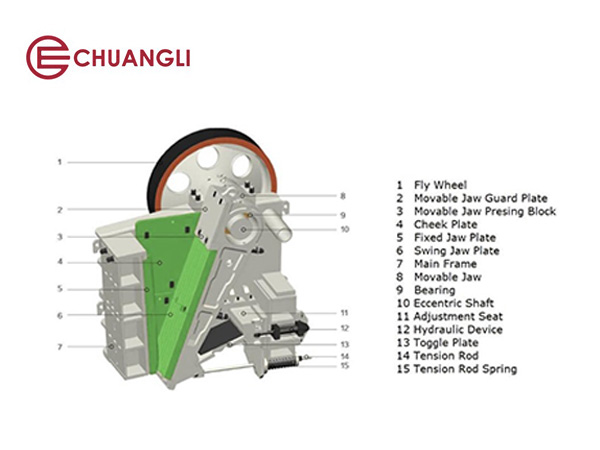
Understanding mechanical principles helps you reduce downstream load effectively. Specific machine features directly dictate plant outcomes. When you master these mechanics, the entire operation runs smoothly.
Standard jaw crusher reduction ratios typically sit between 3:1 and 6:1. This ratio defines how much smaller the output rock is compared to the input rock. Achieving the maximum viable ratio at the primary stage relieves massive downstream stress. If your run-of-mine rock is 24 inches, a 4:1 ratio yields a 6-inch feed. Passing a 6-inch rock to a cone crusher is vastly more efficient than passing a 10-inch rock. Maximizing this initial ratio is critical.
Consistent CSS calibration is your best defense against wear. The CSS determines the maximum size of rock exiting the jaw. Regular calibration produces a highly uniform feed size. This uniformity maximizes the volumetric efficiency of secondary cone or impact crushers. Secondary chambers rely on steady, predictable rock sizes to maintain a continuous choke-feed. A wandering CSS ruins this harmony.
Quarry blasts rarely produce perfectly uniform rock. Dump trucks deliver massive surges of varied material into the hopper. A large feed rock crusher handles these irregularities effortlessly. It relies on tremendous flywheel inertia and high-torque crushing action. The massive flywheels store kinetic energy. This energy powers through tough boulders without stalling the motor. The jaw absorbs the initial shock and delivers a steady, predictable flow to the rest of the plant.
Measure your top feed size directly after a blast.
Adjust the jaw crusher CSS to hit the target reduction ratio.
Monitor the secondary crusher amperage to confirm the load dropped.
Recalibrate the primary CSS weekly as the jaw liners wear down.
Operators must scrutinize equipment closely when shortlisting new machines. Looking at mere tonnage numbers is a dangerous trap. You must evaluate deeper structural and geometric features to ensure true downstream benefits. Selecting the right quarry primary crusher requires a comprehensive evaluation framework.
The nip angle is the angle between the fixed and moving jaw dies. A steep nip angle combined with a deep crushing chamber prevents material slippage. It ensures positive engagement the moment rock enters the machine. If the angle is too wide, rocks "boil" or bounce upward. This boiling wastes energy and allows oversized material to slip through. A proper geometry strictly controls the output gradation.
Pitman kinematics define the actual crushing motion. Aggressive pitman kinematics provide higher capacity. They deliver better crushing action directly at the top of the chamber. This early engagement shatters large boulders immediately. An aggressive stroke length ensures material flows downward quickly, clearing the chamber for the next load.
Hydraulic wedge adjustment systems are now critical necessities. Older shim systems required excessive manual downtime to adjust the CSS. Hydraulic automation allows operators to tweak the CSS in minutes. This encourages daily adjustments. You can maintain a perfectly consistent product size without halting production for hours.
Heavy-duty applications demand exceptional long-term fatigue resistance. You must assess the frame construction carefully. Pinned and bolted frames often handle dynamic stress better than fully welded frames. Welds can develop micro-cracks under constant vibration. Bolted frames flex slightly, absorbing the massive shock loads common in primary rock breaking.
Evaluation Dimension | Standard Feature | Premium Feature | Downstream Impact |
|---|---|---|---|
Nip Angle | Wide Angle (>24 degrees) | Steep Angle (<22 degrees) | Reduces rock bouncing and oversized bypass. |
CSS Adjustment | Manual Shims | Hydraulic Wedges | Ensures consistent secondary feed size. |
Frame Assembly | Fully Welded | Pinned and Bolted | Prevents catastrophic fatigue failures. |
Pitman Stroke | Standard Eccentric | Aggressive Kinematics | Clears chambers faster, increasing TPH. |
Financial justification for a new primary unit requires strict logic. You must look beyond the initial purchase price. The true return on investment lies in operational savings. Capital expenditure makes sense when it drastically cuts your daily running costs.
Crushing earlier in the circuit is always cheaper. We compare the cost of primary breaking versus secondary breaking. Primary machines use heavy mechanical leverage. Secondary machines rely on high speed and attrition. Breaking a 12-inch rock in a jaw crusher uses significantly fewer kilowatts per ton than forcing a cone crusher to do the same work. Shifting the burden forward slashes your monthly utility bills.
Secondary manganese parts are incredibly expensive. Extending their lifespan offsets the initial investment of a premium primary unit. When the primary jaw delivers perfectly sized rock, secondary liners wear evenly. You avoid localized gouging. Operators frequently see secondary liner life double when they optimize their primary stage. This reduction in consumable spending justifies the upfront capital rapidly.
A highly capable primary stage provides critical expansion headroom. When market demand increases, you want to scale total plant throughput. If your primary stage is weak, you must upgrade the entire plant simultaneously. A robust primary crusher gives you the flexibility to upgrade secondary screens or crushers later. It secures your ability to grow without immediate, massive secondary circuit overhauls.
Crushing Stage | Primary Mechanism | Relative Energy Cost | Efficiency Rating |
|---|---|---|---|
Primary Jaw | High Leverage / Slow Speed | Low | High for large boulders |
Secondary Cone | Attrition / High Speed | Medium | Optimal for sizing |
Tertiary Impactor | High Velocity Impact | High | Optimal for shaping |
We must take an evidence-oriented approach to equipment upgrades. A new Primary Jaw Crusher is never a magic bullet if implemented poorly. Operators must recognize and mitigate operational risks early.
A primary crusher out-producing the secondary stage is highly dangerous. If the jaw spits out 500 TPH but the cone only accepts 350 TPH, disaster strikes. You will face constant hopper overflows. Operators will have to frequently stop and start the primary feeder. This start-stop operation increases mechanical wear, burns out motors, and destroys electrical contactors.
You must match the crusher's gape to your actual quarry blast profile. If the jaw opening is too small, massive rocks will bridge across the feed opening. This bridging stops production instantly. Operators must then bring in rock breakers to clear the blockage. This causes highly costly downtime and creates severe safety hazards for personnel.
Dynamic loads are a harsh reality. Upgrading to a heavier, higher-capacity machine fundamentally alters the vibration profile of your plant. Existing concrete foundations often cannot handle the increased dynamic stress. Upgrading usually requires extensive civil engineering work. You may need to pour thicker concrete pads or install reinforced steel chassis upgrades to prevent catastrophic structural failure.
Ignoring the volumetric capacity limits of intermediate conveyors.
Failing to install an adequately sized surge pile between crushing stages.
Purchasing a primary crusher based on average feed size rather than maximum feed size.
Skipping dynamic load analysis on aging plant infrastructure.
Moving forward requires actionable logic. You must gather concrete data before engaging equipment dealers. Smart procurement relies on math, not sales pitches.
The absolute first step is analyzing your Run-of-Mine (ROM) material. Do not look at equipment spec sheets yet. You must understand your rock. Conduct a thorough feed gradation analysis after several typical blasts. Determine your top size, your average size, and your fines content. This data forms the baseline for all subsequent engineering decisions.
Hold your vendors accountable. Demand comprehensive capacity calculation models. Vendors must prove mathematically that the primary output matches your specific secondary crusher's intake curve. Ask for flow-sheet simulations. If a vendor cannot provide software modeling demonstrating the transition from primary to secondary, find another vendor.
Consult with dedicated crushing circuit engineers prior to procurement. Request a full plant audit. Have them model your flow-sheet to identify hidden bottlenecks. Gathering this intelligence ensures your capital investment yields actual operational dominance.
The primary machine acts as the absolute pacemaker of your entire plant. If it struggles, every downstream process suffers. When it operates flawlessly, it shields sensitive secondary equipment from devastating wear and massive energy spikes.
Investing in the correct primary crushing capability is fundamentally an investment in plant longevity. It protects the efficiency of every machine that follows it in the circuit.
Audit your current primary CSS calibration routine immediately.
Track downstream energy spikes and correlate them to primary wear liner degradation.
Conduct a comprehensive ROM feed gradation analysis this quarter.
Consult flow-sheet engineers to model your ideal primary-to-secondary capacity ratio.
A: The ideal reduction ratio generally falls between 3:1 and 6:1. Staying within this range ensures efficient breaking without excessive mechanical strain. Pushing the machine beyond a 6:1 ratio frequently causes severe mechanical fatigue, premature bearing failure, and significant drops in overall throughput.
A: You should check the CSS daily and adjust it at least weekly. This frequency compensates for continuous jaw die wear. Modern machines utilize hydraulic automation, making these adjustments quick and safe. Regular calibration maintains a uniform feed size for downstream machines.
A: No. Primary crushers specialize in bulk size reduction, not precision shaping. They break large boulders into manageable pieces. You still need secondary or tertiary crushers to achieve precise product sizing, improve rock cubicity, and meet strict aggregate specifications.
A: You match them through strict volumetric capacity modeling. Ensure the primary machine's output tonnage does not exceed the secondary machine's intake limit. Establishing an intermediate surge pile or large hopper between stages is crucial to absorb temporary production mismatches and ensure smooth feeding.


