
Views: 0 Author: Site Editor Publish Time: 2026-05-21 Origin: Site


The term stems directly from the Latin word gyrare. It simply translates to moving in a circle. Heavy industry relies deeply on this specific mechanical principle. The eccentric, circular motion perfectly defines the machine's primary crushing head. This exact gyration provides immense mechanical advantage globally. It allows a gyratory crusher to handle massive, continuous material loads effortlessly. Engineers deploy these machines exclusively in high-capacity primary crushing applications. Naming conventions directly match their practical industrial functions.
You must shift focus from mechanical design to core business problems. High throughput defines this massive equipment. Its unique continuous crushing action requires significant upfront capital expenditure. You must determine if this massive investment justifies the high cost. Your specific mining or aggregate operation demands careful financial evaluation. The right procurement decision shapes decades of future operational efficiency. We will explore exactly how you can make this evaluation effectively.
The name "gyratory" dictates the function: a continuously crushing, eccentric circular motion that provides higher throughput than intermittent (jaw) crushers.
Gyratory crushers are strictly for primary stage applications, excelling in high-volume (typically 2,000+ TPH) operations.
Evaluating a unit requires balancing massive upfront CapEx and infrastructure requirements against lower long-term OpEx per ton.
Site footprint, feed size, and maintenance downtime (especially replacing the mantle and concaves) are the primary risk factors in procurement.
You must first understand the fundamental gyration concept. A central main shaft holds a large crushing head. We call this moving head the mantle. It sits securely inside a stationary, cone-shaped outer bowl. Industry professionals refer to this outer shell as the concaves. An eccentric mechanism at the shaft base drives the movement. It forces the bottom of the shaft into an off-center path. The top remains fixed securely in a spider bearing assembly. The mantle does not rotate fully on its axis. Instead, it gyrates in a continuous conical sweeping path. This distinct movement compresses rock against the stationary walls continuously.
You must contrast this continuous action against intermittent equipment. Alternative primary machines operate very differently. Jaw crushers utilize an intermittent open-and-close mechanical action. They crush incoming rock only during the closing stroke. The opening stroke wastes potential processing time entirely. A gyratory design eliminates this dead time completely. It provides a relentless 360-degree continuous crushing action. Material constantly breaks as the mantle sweeps around the entire chamber. You gain uninterrupted production cycles without wasted mechanical strokes.
We map this mechanical design directly to operational efficiency. Continuous motion prevents large rocks from interlocking. You experience significantly fewer bridging issues when processing slabby materials. Slabby materials feature elongated, flat shapes. They easily bridge across rectangular openings found in other machines. The circular chamber prevents this bridging effectively. Gravity pulls the rock down while the mantle shatters it continuously. Interrupted feed lines destroy overall plant productivity. Continuous gyration ensures a highly consistent material flow. This steady stream feeds perfectly into your secondary crushing stages. Plant managers immediately notice smoother overall downstream operations.
You must define what makes a primary crushing stage successful first. Feed acceptance ranks as the absolute highest priority. The machine must swallow massive blast rocks effortlessly. Uninterrupted throughput determines your daily profitability. Unplanned stoppages kill tight operational margins quickly. You also need manageable long-term wear costs. Replacing internal parts drains maintenance budgets rapidly. We evaluate primary machines against these three core performance metrics continuously.
Transparent benchmarks guide smart equipment procurement decisions. Throughput requirements dictate your initial machine choice heavily. Operations running under 1,000 to 1,500 tons per hour (TPH) face clear limits. A jaw crusher often proves much more cost-effective here. The initial infrastructure investment stays relatively low. However, production demands change the entire financial equation. A gyratory crusher becomes the undisputed standard above the 2,000 TPH mark. You simply cannot match its raw volumetric capacity.
Here is a simplified chart comparing these two primary options:
Evaluation Metric |
Gyratory Setup |
Jaw Crusher Setup |
|---|---|---|
Target Capacity |
2,000+ TPH (High Volume) |
Below 1,500 TPH (Low/Medium Volume) |
Crushing Action |
Continuous 360-degree gyration |
Intermittent open-and-close |
Infrastructure Cost |
Extremely high (Deep foundations) |
Moderate (Standard foundations) |
Feed Choke Capability |
Excellent (Thrives under full loads) |
Poor (Requires metered feeding) |
Maximum feed opening demands careful geological evaluation. Run-of-mine (ROM) ore presents highly unique physical characteristics. You must analyze the hardest rock sections in your deposit. Soft limestone shatters very differently than hard granite. Chamber dimensions must accommodate the absolute largest expected blast fragments. Undersized openings cause dangerous, time-consuming material blockages. You must align the machine's physical geometry to your specific geology precisely.
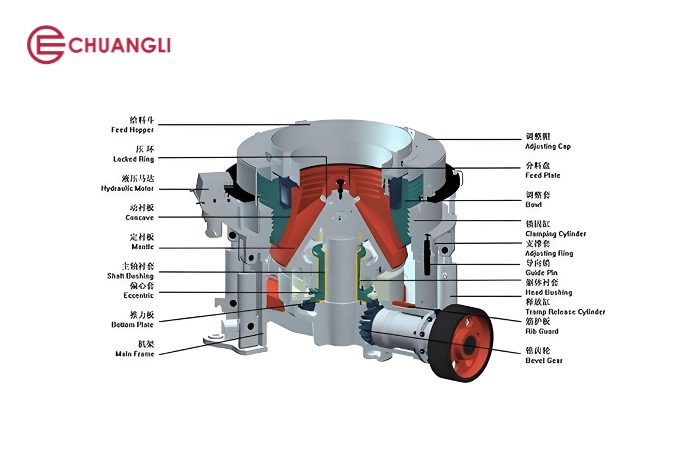
You must assess various chamber design options carefully. Motor sizing plays a critical role in your future planning. Mines often expand their production targets over several years. The machine must scale alongside your projected mine life. Quarry expansions demand robust built-in capacity reserves. Underpowered equipment throttles future growth potential severely. You should procure a unit capable of handling tomorrow's tonnage today.
Modern hydraulic adjustment systems transform heavy plant operations. We call this the Closed Side Setting (CSS) control system. Older models required dangerous manual shim adjustments constantly. Workers spent hours physically altering the machine settings. Modern systems eliminate this dangerous manual labor entirely. A massive hydraulic cylinder supports the main shaft assembly underneath. Operators adjust the CSS with a simple control room button. You can optimize the product size continuously during full operation. The system also monitors hydraulic pressure spikes instantly. It lowers the shaft automatically if tramp iron enters the chamber. Tramp iron includes uncrushable items like broken excavator teeth. Removing these hazards quickly prevents catastrophic main shaft fractures.
Analyzing kilowatt-per-ton (kW/t) efficiency reveals true operational value. These motors possess massive overall power ratings. Large units utilize motors exceeding 1,000 horsepower easily. The initial electrical requirements often look intimidating to procurement teams. However, continuous crushing yields superior energy efficiency per ton produced. The steady mechanical action prevents massive torque spikes upon startup. You maintain a highly stable power draw on the local grid. This stability lowers overall electrical utility demand charges. You avoid the extreme energy spikes common in intermittent crushing operations.
Follow these specific evaluation steps during procurement:
Calculate maximum future tonnage requirements for the next decade.
Analyze physical chamber dimensions against your largest blast fragments.
Review hydraulic control system capabilities for automated wear compensation.
Measure expected power efficiency per processed ton accurately.
Assess regional aftermarket support and spare part availability.
Massive physical footprints define these industrial giants. You must address significant infrastructure requirements extremely early. They require incredibly deep, heavily reinforced concrete foundations. Engineers design these structures to absorb immense dynamic vibrations continuously. Poor foundation design leads to structural cracking and catastrophic failure. Site topography dictates installation feasibility heavily. Flat sites require extensive ramps or deep excavation work. You also need significant vertical clearance. 400-ton haul trucks must dump directly into the massive feed hopper. The retaining structures endure massive impact loads constantly. Proper civil engineering accounts for over 30% of the total installation cost.
You must plan for major maintenance challenges realistically. Removing the massive eccentric assembly requires specialized overhead lifting gear. Replacing heavy manganese concaves takes significant planning and time. The concaves arrive in heavy, segmented tiers. Replacing them requires skilled rigging teams and precise heating techniques. Workers pour backing compound to secure the heavy liners tightly. This curing process adds hours to your planned downtime. You must schedule these shutdowns carefully to protect quarterly targets. Many operations keep complete spare assemblies nearby constantly. This strategy minimizes critical replacement downtime substantially. We strongly recommend building a dedicated overhead crane system above the station.
You face extreme upfront costs initially. We acknowledge this massive financial barrier transparently. Purchasing and installing this equipment strains capital budgets (CapEx) heavily. However, you must focus on the long-term break-even timeline. High-volume operations drive down the operational expenditure (OpEx) efficiently. The operational expenditure remains incredibly low per processed ton. High volume dilutes the capital burden effectively over decades. The machine easily runs for 40-50 years with proper care. You recover the initial investment through sheer continuous material volume. Focus on long-term efficiency rather than initial sticker shock.
Review these common maintenance risks before purchasing:
Extended downtime during complex concave tier replacements.
High costs associated with maintaining specialized heavy lifting equipment.
Logistical challenges when ordering massive spare parts globally.
Extended training periods required for new maintenance personnel.
Prolonged curing times for manganese backing compounds.
You need a structured approach to evaluate an Original Equipment Manufacturer (OEM). Look closely at their dedicated aftermarket support networks. Parts availability dictates your long-term success entirely. A cheaper machine costs millions in lost production if spares remain unavailable. You must investigate the OEM's local supply chain capabilities. An OEM based thousands of miles away poses severe logistical risks. Ask about their regional parts warehouses and field service technicians. Determine their average response time for critical emergency breakdowns. Review their historical reliability in similar geological conditions. Ask for case studies involving your specific rock type. Contact existing customers running the exact same model. Ask them about real-world liner wear rates and hydraulic reliability.
Operations teams must gather exact data before contacting manufacturers. Vague requests yield highly inaccurate pricing models. Accurate geological data prevents expensive under-sizing mistakes.
Data Requirement |
Description |
Why It Matters for Quoting |
|---|---|---|
ROM Hardness & Abrasiveness |
Bond Work Index (BWI) laboratory data. |
Directly influences motor sizing and manganese liner material selection. |
Desired Product Size |
Target CSS and particle output curve. |
Determines the required internal chamber profile and secondary feed rate. |
Max Feed Size |
Top size of blast rock entering the hopper. |
Dictates the physical dimensions of the top feed opening. |
Target TPH |
Tons per hour (average and peak). |
Defines the overall machine scale and required power capacity. |
Site Altitude & Climate |
Elevation, max/min ambient temperatures. |
Impacts motor cooling efficiency and hydraulic lubrication fluid selection. |
You must specify your climatic extremes clearly. Mining at high altitudes requires specialized motor cooling solutions. Thin air reduces standard motor cooling efficiency significantly. Arctic climates require specialized hydraulic fluid heaters. Tropical environments demand upgraded dust suppression and sealing systems. Provide all this detailed data upfront to secure accurate vendor bids.
The namesake circular motion explains its absolute dominance globally. This continuous sweeping action defines mega-scale primary crushing completely. It outpaces intermittent machines through relentless, uninterrupted material processing. The sheer scale of these units transforms raw mining efficiency securely. Your primary crushing stage dictates the entire plant's production rhythm. A perfectly sized machine ensures secondary and tertiary crushers operate smoothly.
Buyers should prioritize long-term site integration capabilities above all else. Focus heavily on how the unit fits into your broader civil infrastructure. The initial engineering and foundation demands remain undeniably immense. Advancing to the Request for Proposal (RFP) stage requires detailed data preparation. Base your final decisions on long-term operational value rather than the baseline sticker price. Smooth continuous processing will ultimately dictate your project's profitability over the coming decades.
A: It refers directly to the eccentric, circular (gyrating) movement of the central main shaft and crushing head within the chamber. This continuous sweeping motion differs completely from a simple linear or rotating movement found in other industrial equipment.
A: They share a similar basic design featuring a mantle gyrating within a bowl. However, a gyratory has a much steeper crushing chamber angle and a significantly larger feed opening. This makes it suited for massive primary crushing. Cone crushers handle smaller secondary or tertiary crushing stages.
A: While heavily site-specific, engineers generally recommend them for operations requiring a minimum of 1,500 to 2,000+ tons per hour. Lower volumes typically favor the lower initial capital expenditure and smaller footprint of a large jaw crusher.
A: The primary wear parts include the mantle and the concaves. The mantle is the moving inner crushing surface. The concaves form the stationary outer crushing surface. Manufacturers typically cast both components from highly durable, high-manganese steel to resist extreme abrasion.


