
Views: 0 Author: Site Editor Publish Time: 2026-05-28 Origin: Site


Linguistically, the term "gyratory" describes a circular, spiral, or revolving motion. It derives directly from the Latin root gȳrāt-. This historical origin paints a clear picture of continuous eccentric movement. You might hear this word and imagine completely different things. It depends entirely on your specific industry and geographic location.
In the United Kingdom, it commonly refers to a complex, massive traffic intersection. However, in heavy industry and mining, it defines one of the most critical pieces of primary size-reduction equipment available today. Understanding this distinction matters greatly for international engineering teams. It prevents costly miscommunications during early facility planning. It also helps procurement teams specify the exact machinery needed for mineral processing operations.
This article clarifies the true definition of the word. We will resolve the common traffic terminology confusion once and for all. You will also gain a comprehensive evaluation framework. This practical framework helps you assess whether an industrial gyratory crusher fits your specific operational requirements.
Dual Definition: "Gyratory" acts as an adjective describing eccentric, circular motion, and as a noun for specialized British traffic roundabouts.
Industrial Application: In heavy machinery, the term refers to the core operational mechanic of a gyratory crusher—a cone-shaped mantle rotating eccentrically within a bowl.
Decision Stage Reality: Choosing gyratory equipment over alternatives (like jaw crushers) requires justifying a higher initial CapEx with sustained, high-capacity throughput and continuous feed capabilities.
Implementation Risk: The massive footprint of gyratory equipment demands rigorous civil engineering, precise foundation planning, and specialized maintenance protocols.
Etymology traces this fascinating word back to the 1810s. The first recorded use appeared in published literature around 1815. It peaked in linguistic frequency during the Second Industrial Revolution in the early 1900s. Rotating heavy machinery became the absolute standard worldwide during this transformative era. Engineers needed specific vocabulary to describe these entirely new mechanical actions.
As an adjective, it describes an object moving in a continuous circle or spiral. Think of the three-dimensional motion seen in laboratory mixing rockers. These scientific devices gently swirl biological samples inside vials. They rely heavily on this specific eccentric movement. The motion prevents liquid separation while protecting delicate cellular structures. It provides a highly consistent, non-disruptive agitation phase.
As a noun, the term defines highly specific traffic infrastructure. This directly addresses a highly searched question online. What separates a gyratory from a standard roundabout? A roundabout acts as a standard circular intersection. A traffic gyratory operates on a distinctly larger scale. Hanger Lane in the UK serves as a famous, prime example. It features non-standard lane priorities. It also frequently contains physical buildings on the central island. Complex transit infrastructure often sits directly in the middle of the traffic flow. You rarely see standard right-of-way rules apply here seamlessly. Drivers must navigate multiple interconnected junctions continuously.
How does eccentric, circular motion translate into industrial chemical engineering? How does it apply to heavy mining? The term effectively bridges a pure physical concept to a massive practical application.
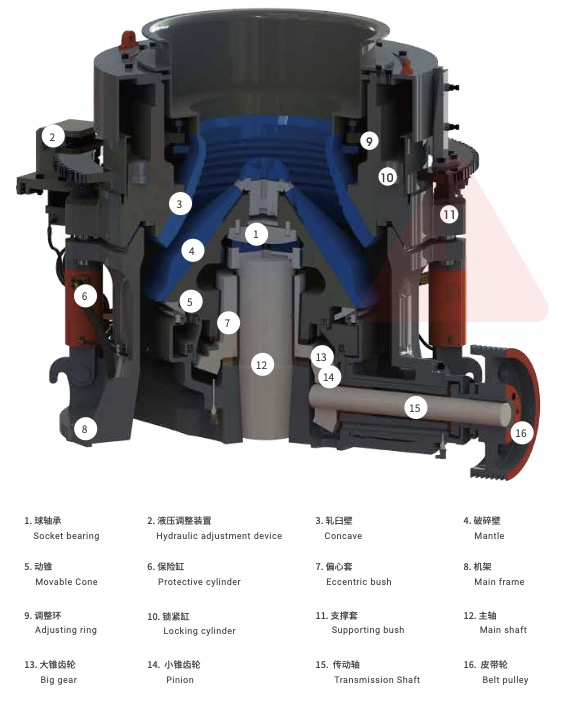
The equipment mechanics reveal this direct connection clearly. The machine utilizes a massive vertical main shaft. A cone-shaped rod, known as a mantle, mounts securely onto this robust shaft. This assembly rotates eccentrically within a much larger cone-shaped bowl. Industry professionals call this outer bowl the concaves. The mantle does not spin perfectly on center. It wobbles slightly off-axis. This continuous oscillating motion traps heavy rock efficiently. It crushes the material relentlessly against the outer bowl using extreme compressive force.
Its primary function sets the production pace for the whole operation. It acts as the critical first line of defense in comminution circuits. Engineers design it specifically to crush massive run-of-mine (ROM) ore. It reduces these giant boulders into highly manageable sizes. The downstream equipment relies completely on this initial size reduction. Secondary processing equipment simply cannot handle raw, oversized blasts directly from the pit.
Material suitability dictates its overall deployment strategy across mine sites. It proves highly effective for hard, abrasive, and blocky materials. You can rely on it confidently for tough igneous rock. It easily handles highly abrasive metallic ores like copper and iron. However, it proves significantly less ideal for heavily clay-bound ores. Sticky materials cause severe operational problems. Without specific structural modifications, wet clay quickly clogs the crushing chamber. Production grinds to a halt almost immediately.
Plant managers typically evaluate these two primary crushers during the early facility design phase. This business problem framing matters immensely. The choice ultimately dictates the physical design of the entire downstream plant structure.
Throughput and capacity highlight the biggest divergence between the two technologies. The gyratory crusher delivers a continuous crushing action. It crushes rock continuously on the full 360-degree cycle. This mechanical advantage makes it ideal for mega-scale mining operations. It handles demands ranging from 1,000 to well over 10,000 tonnes per hour (tph). The jaw alternative offers an intermittent crushing action. It crushes only on the forward stroke. Therefore, it suits lower throughput requirements much better.
Feed characteristics also separate the two machines significantly. The continuous machine handles blocky, uniform feed beautifully. It allows direct dumping from massive mining haul trucks. You can skip extensive pre-scalping steps entirely. Conversely, the jaw machine handles slabby material much better. It requires controlled, highly metered feeding. Operators usually achieve this steady feed using heavy-duty apron feeders.
Cost profiles look very different for both options. The continuous option demands extremely high initial CapEx. It requires massive civil foundation investments upfront. However, it delivers a uniquely lower cost-per-ton at ultra-high production volumes. The jaw alternative offers a noticeably lower initial CapEx. It demands a much smaller installation footprint. You can even find highly mobile tracked options available for flexible site work.
Evaluation Dimension |
Gyratory Equipment |
Jaw Equipment |
|---|---|---|
Crushing Action |
Continuous (Full 360-degree cycle) |
Intermittent (Forward stroke only) |
Peak Capacity limits |
>10,000 tonnes per hour |
Typically <1,500 tonnes per hour |
Primary Feed Method |
Direct dump from heavy haul trucks |
Metered feed via large apron feeders |
Ideal Material Profile |
Blocky, highly abrasive ore bodies |
Slabby, highly variable rock types |
Footprint & Civil Work |
Massive, deeply excavated foundation |
Compact, requiring minimal excavation |
Scalability and automation represent critical procurement factors today. Modern units require extensive integration into plant-wide SCADA systems. This digital integration lets operators monitor the mantle position remotely. They can track the electrical power draw in real-time. Automated main shaft positioning also compensates for liner wear dynamically. The system adjusts the shaft height automatically. This maintains a highly consistent closed-side setting without manual human intervention.
Apply a practical experience lens to maintenance realities. You must evaluate the top-serviceability of the unit carefully. Can maintenance teams remove the heavy spider assembly efficiently? How complex is the eccentric bushing replacement? These heavy components require massive overhead cranes to lift safely.
Evaluate structural vertical clearance limits carefully during the initial design phase.
Assess the overall accessibility of the hydraulic lubrication skid.
Review the expected replacement frequency of the mantle liners based on ore abrasiveness.
Ensure adequate laydown areas exist nearby for massive spare parts.
If the facility design lacks adequate vertical clearance, routine maintenance turns into a logistical nightmare. You will face extended downtime.
Compliance and safety remain completely non-negotiable in modern mining environments. Heavy environmental regulations demand highly enclosed dust suppression systems. Airborne silica dust poses severe long-term health risks to personnel. Occupational safety compliance requires automated rock breaker integrations. Operators can no longer manually clear bridged rocks safely using pry bars. Automation removes personnel from the hazardous crushing zone entirely. Remote-controlled hydraulic arms break oversized boulders safely from a distant control room.
Civil engineering dependencies pose the greatest initial installation risk. The extreme height and weight of this equipment require massive concrete foundations. You must excavate deeply into solid bedrock to secure the site. Contractors must pour thousands of cubic yards of specialized concrete. Concrete curing times alone dictate large sections of the project schedule. Any unexpected delays in civil works will quickly derail the entire installation timeline. Soil bearing capacity must meet extreme engineering standards before any steel arrives.
The choke feeding assumption often traps inexperienced plant operators. This specific machinery operates most efficiently when choke fed. This means keeping the primary crushing chamber consistently full of rock.
Underfeeding causes rocks to bounce excessively inside the massive chamber.
This chaotic bouncing leads to poor particle shape and severe flakiness.
It also causes accelerated, highly uneven liner wear across the concaves.
Ultimately, you waste immense amounts of electrical energy processing empty space.
Operators must balance the truck dispatch rates perfectly. The haul truck feed rate must match the actual processing speed exactly.
Logistical constraints frequently surprise project management teams. Transporting the main shaft and spider assembly poses serious challenges globally. You often need highly specialized heavy-haul logistics providers. The transportation route may require temporary highway closures. Bridges along the specified route might require structural reinforcements to handle the extreme weight. These hidden logistical factors add massive costs during the early procurement stage. You must plan the delivery route many months in advance.
The term has traveled a fascinating path through history. It started as a pure linguistic definition of revolving motion in the early 1800s. Today, it represents the ultimate expression of heavy industrial power and global mineral processing.
Investing in a gyratory crusher remains a fundamental facility design decision. You are not just buying a single piece of equipment. You are establishing the entire processing heartbeat of your plant. The wrong choice limits your overall production ceiling permanently. It forces downstream processes to compensate for poor initial size reduction.
Map your absolute peak throughput requirements immediately. You must also evaluate your site's complex foundation constraints thoroughly. Complete these crucial steps before shortlisting OEMs for your primary size-reduction needs. This diligent approach ensures a successful, highly efficient processing operation.
A: A roundabout is a standard circular traffic intersection. A traffic gyratory operates on a much larger scale. It features non-standard right-of-way rules and complex lane markings. It also frequently contains physical buildings or transit infrastructure located directly on the central island.
A: It is a highly specialized civil engineering tool. Technicians use it to test asphalt mixtures in laboratories. The machine applies a constant rotating, eccentric pressure to the asphalt. This simulates the real-world compaction caused by heavy vehicular traffic over time.
A: The name derives directly from its specific mechanical action. The machine utilizes a cone-shaped mantle mounted on a vertical axis. This mantle moves in an eccentric, revolving motion within an outer bowl. This continuous circular wobble physically crushes the inserted rock.
A: The earliest recorded use traces back to the 1810s. Literature from circa 1815 shows its initial linguistic appearance. However, the term's usage peaked significantly during the early 1900s. This surge aligned directly with the rapid mechanization of the Second Industrial Revolution.


